Introduction and Welcome

Welcome to All Things Bright and Beautiful. If you are new to this site, I would recommend that you read my very first entry - which is an introduction and welcome to this blog. You can view it here

Monday, October 29, 2012

Albert Bierstadt - Among the Sierra Nevadas, Wolfgang Amadeus Mozart - Clarinet Concerto in A Major, John Greenleaf Whittier -

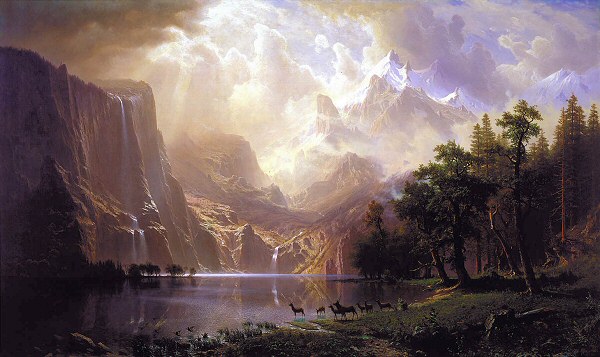
This lovely painting by  Albert Bierstad is a beautiful mountain scene.  He is extravagant in his wonderful skies and does a great job of portraying the grandeur of the scene.

Albert Bierstadt - Among the Sierra Nevadas


This week's piece by Wolfgang Amadeus Mozart is Clarinet Concerto in A Major is a rather sedate piece but beautiful and peaceful.  For more information on the Clarinet and to see a picture of one read here.

A final celebration of Fall as we wait for winter's snows (at least here in the Midwest) with a poem by John Greenleaf Whittier. 
The Huskers
It was late in mild October, and the long autumnal rain
Had left the summer harvest-fields all green with grass again;
The first sharp frosts had fallen, leaving all the woodlands gay
With the hues of summer's rainbow, or the meadow flowers of May.


Through a thin, dry mist, that morning, the sun rose broad and red,
At first a rayless disk of fire, he brightened as he sped;
Yet, even his noontide glory fell chastened and subdued,
On the cornfields and the orchards, and softly pictured wood.


And all that quiet afternoon, slow sloping to the night,
He wove with golden shuttle the haze with yellow light;
Slanting through the painted beeches, he glorified the hill;
And, beneath it, pond and meadow lay brighter, greener still.


And shouting boys in woodland haunts caught glimpses of that sky,
Flecked by the many-tinted leaves, and laughed, they knew not why;
And school-girls, gay with aster-flowers, beside the meadow brooks,
Mingled the glow of autumn with the sunshine of sweet looks.


From spire and barn looked westerly the patient weathercocks;
But even the birches on the hill stood motionless as rocks.
No sound was in the woodlands, save the squirrel's dropping shell,
And the yellow leaves among the boughs, low rustling as they fell.


The summer grains were harvested; the stubblefields lay dry,
Where June winds rolled, in light and shade, the pale green waves of rye;
But still, on gentle hill-slopes, in valleys fringed with wood,
Ungathered, bleaching in the sun, the heavy corn crop stood.


Bent low, by autumn's wind and rain, through husks that, dry and sere,
Unfolded from their ripened charge, shone out the yellow ear;
Beneath, the turnip lay concealed, in many a verdant fold,
And glistened in the slanting light the pumpkin's sphere of gold.


There wrought the busy harvesters; and many a creaking wain
Bore slowly to the long barn-floor is load of husk and grain;
Till broad and red, as when he rose, the sun sank down, at last,
And like a merry guest's farewell, the day in brightness passed.


And lo! as through the western pines, on meadow, stream, and pond,
Flamed the red radiance of a sky, set all afire beyond,
Slowly o'er the eastern sea-bluffs a milder glory shone,
And the sunset and the moonrise were mingled into one!


As thus into the quiet night the twilight lapsed away,
And deeper in the brightening moon the tranquil shadows lay;
From many a brown old farm-house, and hamlet without name,
Their milking and their home-tasks done, the merry huskers came.


Swung o'er the heaped-up harvest, from pitchforks in the mow,
Shone dimly down the lanterns on the pleasant scene below;
The growing pile of husks behind, the golden ears before,
And laughing eyes and busy hands and brown cheeks glimmering o'er.


Half hidden, in a quiet nook, serene of look and heart,
Talking their old times over, the old men sat apart;
While up and down the unhusked pile, or nestling in its shade,
At hide-and-seek, with laugh and shout, the happy children played.


Urged by the good host's daughter, a maiden young and fair,
Lifting to light her sweet blue eyes and pride of soft brown hair,
The master of the village school, sleek of hair and smooth of tongue,
To the quaint tune of some old psalm, a husking-ballad sung.


Thursday, October 25, 2012

Albert Bierstadt-Harbor Scene, Wolfgang Amadeus Mozart - Turkish March, John Greenleaf Whittier - Storm on Lake Asquam

Albert Bierstadt was a Hudson River School painter like Thomas Cole.  His paintings are wonderfully detailed scenes of early America in a realistic style. 

 Two sites with background biographies follow:  Wikipedia - Albert Bierstadt or Albert Bierstadt The second site has many of his paintings that you can view.  

Harbor Scene - Albert Bierstadt - www.albertbierstadt.org

Our music by Wolfgang Amadeus Mozart today is a light energetic piano piece called Turkish March.

 Wonderful descriptive words follow in this week's poem by
 John Greenleaf Whittier -

                     Storm on Lake Asquam
A cloud, like that the old-time Hebrew saw
On Carmel prophesying rain, began
To lift itself o'er wooded Cardigan,
Growing and blackening. Suddenly, a flaw

Of chill wind menaced; then a strong blast beat
Down the long valley's murmuring pines, and woke
The noon-dream of the sleeping lake, and broke
Its smooth steel mirror at the mountains' feet.

Thunderous and vast, a fire-veined darkness swept
Over the rough pine-bearded Asquam range;
A wraith of tempest, wonderful and strange,
From peak to peak the cloudy giant stepped.

One moment, as if challenging the storm,
Chocorua's tall, defiant sentinel
Looked from his watch-tower; then the shadow fell,
And the wild rain-drift blotted out his form.

And over all the still unhidden sun,
Weaving its light through slant-blown veils of rain,
Smiled on the trouble, as hope smiles on pain;
And, when the tumult and the strife were done,

With one foot on the lake and one on land,
Framing within his crescent's tinted streak
A far-off picture of the Melvin peak,
Spent broken clouds the rainbow's angel spanned.


Thursday, October 18, 2012

Frederic Remington - Small Oaks, Wolfgang Amadeus Mozart - Piano Concerto No. 21 - Andante, John Greenleaf Whittier - Dear Lord and Father of Mankind

A final painting by Frederic Remington this week. Perhaps I was drawn to this painting because our family enjoys camping.  The book I found this painting in said that this painting "reflects the comfortable Adirondack-style camping favored by the artist and his wife."  
Small Oaks - Frederic Remington
Wolfgang Amadeus Mozart -

 Mozart - Piano Concerto No. 21 - Andante

Our poem this week by John Greenleaf Whittier is sung as a hymn.
you can hear it here
or print an alternate tune (one I'm more familiar with) here
or download tunes from The Cyber Hymnal here 

            Dear Lord and Father of Mankind
Dear Lord and Father of mankind,
Forgive our foolish ways;
Reclothe us in our rightful mind,
In purer lives Thy service find,
In deeper reverence, praise.


In simple trust like theirs who heard,
Beside the Syrian sea,
The gracious calling of the Lord,
Let us, like them, without a word,
Rise up and follow Thee.


O Sabbath rest by Galilee,
O calm of hills above,
Where Jesus knelt to share with Thee
The silence of eternity,
Interpreted by love!


With that deep hush subduing all
Our words and works that drown
The tender whisper of Thy call,
As noiseless let Thy blessing fall
As fell Thy manna down.


Drop Thy still dews of quietness,
Till all our strivings cease;
Take from our souls the strain and stress,
And let our ordered lives confess
The beauty of Thy peace.


Breathe through the heats of our desire
Thy coolness and Thy balm;
Let sense be dumb, let flesh retire;
Speak through the earthquake, wind, and fire,
O still, small voice of calm.


Thursday, October 11, 2012

Frederic Remington - Radisson and Groseilliers, Wolfgang Amadeus Mozart, John Greenleaf Whittier - Requirement

I was thinking of moving on from Frederic Remington but I found two more paintings in a library book on Remington and Russell that are quite different from the others we've done and I'd like to feature them this week and next before we move on.  Remington was asked to do an illustrated series on the early explorers of North America.  This is a picture of French voyageurs.  One thing I noticed, even though the canoe is almost horizontal in the picture, the artist manages to make it look like the right side is more distant and the left end is much closer.  He does this by making the right side of the canoe about half the height of the left side.  He also makes more of the contrast between light and dark in the closer end of the canoe and more detail in the Indians in the front (left side).  I've mentioned before Remington's common use of red, yellow and blue and you notice that in this painting.  Artists show water by using reflections - this might be a fun painting to try to copy.  The French explorer stands in the middle of the canoe.  He is dressed quite differently from the Indians.  

Radisson and Groseilliers - Frederic Remington

An energetic piece by Wolfgang Amadeus Mozart - Symphony #40. 
 Mozart - Symphony No. 40 in G minor

John Greenleaf Whittier's poem today has some meaty thoughts clothed in beautiful language.  

                           Requirement
We live by Faith; but Faith is not the slave
Of text and legend. Reason's voice and God's,
Nature's and Duty's, never are at odds.
What asks our Father of His children, save
Justice and mercy and humility,
A reasonable service of good deeds,
Pure living, tenderness to human needs,
Reverence and trust, and prayer for light to see
The Master's footprints in our daily ways?
No knotted scourge nor sacrificial knife,
But the calm beauty of an ordered life
Whose very breathing is unworded praise!--
A life that stands as all true lives have stood,
Firm-rooted in the faith that God is Good.


Thursday, October 4, 2012

Frederic Remington, Wolfgang Amadeus Mozart Piano Concerton No. 21 Andante, John Greenleaf Whittier - Trust


Another bronze sculpture by Frederic Remington this week. So many of his works include horses and action - this is no exception. If you are looking for a more of Remington's work check out this site.


The Mountain Man by Frederic Remington

 
Wolfgang Amadeus Mozart is well known and much loved in classical music.  I hope you enjoy the next few weeks as we feature his work.  Following are a couple of links to short biographical sketches of his life and information about his life and works.
Wolfgang Amadeus Mozart - Wikipedia
The Mozart Project

I hope you will enjoy this peaceful piece by Mozart - Mozart - Piano Concerto No.21 Andante (You can skip the ad after the first bit.)

Another wonderful poem by John Greenleaf Whittier:

Trust
The same old baffling questions! O my friend,
I cannot answer them. In vain I send
My soul into the dark, where never burn
The lamps of science, nor the natural light
Of Reason's sun and stars! I cannot learn
Their great and solemn meanings, nor discern
The awful secrets of the eyes which turn
Evermore on us through the day and night
With silent challenge and a dumb demand,
Proffering the riddles of the dread unknown,
Like the calm Sphinxes, with their eyes of stone,
Questioning the centuries from their veils of sand!
I have no answer for myself or thee,
Save that I learned beside my mother's knee;
"All is of God that is, and is to be;
And God is good." Let this suffice us still,
Resting in childlike trust upon His will
Who moves to His great ends unthwarted by the ill.


Thursday, September 27, 2012

Frederic Remington - The Bronco Buster, Brahms - Requiem, John Greenleaf Whittier - All's Well

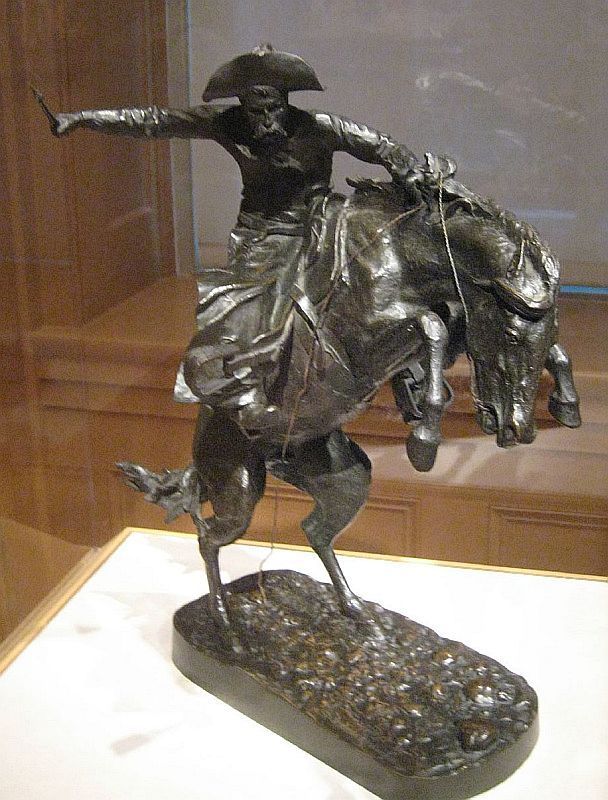
A look at the work of Frederic Remington wouldn't be complete without a look at a couple of his sculptures. The Bronco Buster which he sculpted in 1909 was his most popular work.  It measures 31 1/8" by 13" by 17 1/2".  Remington was a self-taught sculptor and this was his first work cast in bronze. 


The following is a link to a museum article about this bronze statue The Bronco Buster Article


A final work by Johannes Brahms this week, an excerpt from Requiem.  A Requiem is a mass for the souls of the dead.  Brahms Requiem How Lovely is Thy Dwelling Place

John Greenleaf Whittier had an amazing faith and it comes through with powerful spiritual insights like this one.
 

                  All's Well
The clouds, which rise with thunder, slake
Our thirsty souls with rain;
The blow most dreaded falls to break
From off our limbs a chain;
And wrongs of man to man but make
The love of God more plain.
As through the shadowy lens of even
The eye looks farthest into heaven
On gleams of star and depths of blue
The glaring sunshine never knew!

Friday, September 21, 2012

Frederic Remington - The Old Stage Coach of the Plains, Johannes Brahms - Walz,

Last week's painting by Frederic Remington was also a night scene.  This one is even darker and yet the artist successfully portrays his subject even in the limited light.  Notice that there is very little color and what is there is grayed at night so things have to be shown with dark and light. Your eye goes up, up to the stagecoach with your eye drawn to the lantern and window which are placed in an ideal position for the focus according to the rule of thirds. (see article here).  You feel the lonely ruggedness both by the atmosphere and by the attentiveness of men and animals.  I hope your computer screen shows this painting more clearly than mine especially as this was the largest I could make the image - if not consider finding a book of Remington's works.  A link follows to a short article about this painting here.


Johannes Brahms Waltz has a wonderful happy swing to it.  You can easily count the three beats per measure.  Johannes Brahms - Waltz  

I have enjoyed a few of John Greenleaf Whittier's poems before but when I started looking for poems to post I was amazed by the deep, rich lines of his poetry.  It's hard to choose which ones to share.  The following link will take you to Ambleside Online's listing of his poems Ambleside - John Greenleaf Whittier.  In this long poem celebrating his humble, love relationship with God Whittier rhymes the first and third lines and the second and fourth in each stanza.


The Eternal Goodness
O friends! with whom my feet have trod
The quiet aisles of prayer,
Glad witness to your zeal for God
And love of man I bear.


I trace your lines of argument;
Your logic linked and strong
I weigh as one who dreads dissent,
And fears a doubt as wrong.


But still my human hands are weak
To hold your iron creeds:
Against the words ye bid me speak
My heart within me pleads.


Who fathoms the Eternal Thought?
Who talks of scheme and plan?
The Lord is God! He needeth not
The poor device of man.


I walk with bare, hushed feet the ground
Ye tread with boldness shod;
I dare not fix with mete and bound
The love and power of God.


Ye praise His justice; even such
His pitying love I deem:
Ye seek a king; I fain would touch
The robe that hath no seam.


Ye see the curse which overbroods
A world of pain and loss;
I hear our Lord's beatitudes
And prayer upon the cross.


More than your schoolmen teach, within
Myself, alas! I know:
Too dark ye cannot paint the sin,
Too small the merit show.


I bow my forehead to the dust,
I veil mine eyes for shame,
And urge, in trembling self-distrust,
A prayer without a claim.


I see the wrong that round me lies,
I feel the guilt within;
I hear, with groan and travail-cries,
The world confess its sin.


Yet, in the maddening maze of things,
And tossed by storm and flood,
To one fixed trust my spirit clings;
I know that God is good!


Not mine to look where cherubim
And seraphs may not see,
But nothing can be good in Him
Which evil is in me.


The wrong that pains my soul below
I dare not throne above,
I know not of His hate, -- I know
His goodness and His love.


I dimly guess from blessings known
Of greater out of sight,
And, with the chastened Psalmist, own
His judgments too are right.


I long for household voices gone,
For vanished smiles I long,
But God hath led my dear ones on,
And He can do no wrong.


I know not what the future hath
Of marvel or surprise,
Assured alone that life and death
His mercy underlies.


And if my heart and flesh are weak
To bear an untried pain,
The bruisèd reed He will not break,
But strengthen and sustain.


No offering of my own I have,
Nor works my faith to prove;
I can but give the gifts He gave,
And plead His love for love.


And so beside the Silent Sea
I wait the muffled oar;
No harm from Him can come to me
On ocean or on shore.


I know not where His islands lift
Their fronded palms in air;
I only know I cannot drift
Beyond His love and care.


O brothers! if my faith is vain,
If hopes like these betray,
Pray for me that my feet may gain
The sure and safer way.


And Thou, O Lord! by whom are seen
Thy creatures as they be,
Forgive me if too close I lean
My human heart on Thee!